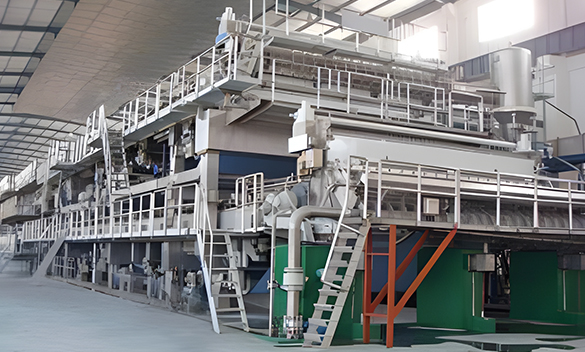
Joint equipment for paper copying. Mainly composed of parts such as mesh, pressing, and drying. There are two types of mesh: circular mesh and long mesh. The press section is composed of a press roller and paper wool. The drying section consists of one or several drying cylinders. Some long web machines are also equipped with mechanical calenders to improve the smoothness and tightness of the paper. There are many types of paper machines, such as the single drying cylinder paper machine (also known as the Yankee paper machine) for making single sided glossy paper, the long mesh multi drying cylinder paper machine for making general paper, the thin sheet paper machine for making typing paper and cigarette paper, and the cardboard machine for making cardboard. 1. Basic data expressing the production capacity and adaptability of paper machines The main technical features that express the production capacity and adaptability of paper machines include net paper width, high working speed, adjustment range, forming section, pressing section, and drying section. 2. Basic data expressing the performance and structure of various parts of a paper machine In order to improve the standardization, serialization, and generalization of paper machine design and manufacturing, it is also necessary to include the main structural data of each part of the paper machine in the design parameters of the paper machine. These structural data include the size and surface layer technical characteristics of various rollers, the size and quantity of panels, the size and quantity of drying cylinders, and the gauge and bearing distance of each part. 3. Data representing the overview of paper machines Data showing the general situation of small paper machines, such as the length of the whole machine, the total mass, the height from the rail surface, the height of the bottom floor, the total installed power of the transmission system, etc., show the technical and economic indicators of the paper machine, such as the floor area, the space volume, the unit production capacity, the body mass, and the power consumption, which can not be ignored.
Various types of flat burning paper can be produced using a hot kang paper machine, with low investment, low requirements, and high output. It does not require the use of a boiler and belongs to direct heating. Four Methods of Papermaking Material Technology 1. Using leftover materials from the printing factory, white paper edges, wood pulp, cotton pulp, and straw pulp to produce toilet paper, napkins, book paper, and student paper can be directly made into paper, with a simple process 2. Using waste books and newspapers as toilet paper, napkins, whiteboard paper, and student paper requires a deinking machine, rinsing and whitening process, with a larger investment and a larger site, depending on the model. 3. The process of using bamboo, bamboo pulp, crushing, beating, and other techniques to make burnt paper and earthen paper is simple. 4. Use waste paper boxes and cardboard boxes to make fireworks paper, burnt paper, earthen paper, packaging paper, yellow board paper, and corrugated paper. 5. The waste slurry from the floor drain of a large pulp making factory is recycled and treated before use. Four methods of heating, drying, and disinfection 1. Use electricity to transfer and dry. 2. Oil and gas boilers generate steam for drying, which is advocated by environmental protection countries and requires significant investment. 3. Use a coke or coal or gas generator to directly steam dry (referred to as a combustion cylinder). 4. The method is to use coal-fired boilers to generate steam for heating and drying, saving energy, achieving uniform drying, and improving production, quality, and speed. The above four options are determined based on local conditions. 1、 This machine does not use wheat straw for paper making or caustic soda cooking, so it does not need to be rinsed, does not discharge water, and does not cause pollution to the environment without sludge. 2、 Waste paper making involves soaking and refining only two tons of water per ton of paper. The water squeezed by the rollers passes through the water channel and sink to the recycling pool, where it is recycled and reused without removing a drop of water. There is no discharge to the outside, which is a waste of water source. 3、 Waste paper recycling, original color of the original paper, without the need for adding any chemical raw materials or additives. 4、 The paper made by the Huokang paper machine is recycled from waste paper into raw paper, which has no odor and will not cause any harm to the human body or pollute the air.
The paper machine can be roughly divided into the main machine part and the auxiliary system part; The host part is roughly divided into wet parts, cadres, and curls. The wet part can be understood as the part of the paper with a relatively high water content; Cadres are the parts of paper that have little moisture and are considered dry; Curling is the mechanism by which a page of paper is rolled up. Referring to the picture content, the headbox, mesh part, and pressure part can be considered as wet parts; Drying, gluing, coating, and calendering are considered cadres; And then there's curling. Please do not delve deeply into the concept of classification as it does not involve academia. Auxiliary system, literally, refers to the part that assists the host in implementing its functions. For modern high-speed paper machines, each system is complementary and there is no distinction between primary and secondary functions or functions. The auxiliary system is just a term. Just like mobile phones, in addition to making phone calls and SMS functions, there are also various functions such as taking photos, socializing, and wallets to meet people's needs for quality of life and efficiency. The fire paper paper machine is also necessary to pursue high efficiency, and the so-called auxiliary system is already essential.